Trying to decide between a condo, townhome, or single‑family house in Sandy Springs? You are not alone. The city offers everything from Perimeter‑area high‑rises to river‑corridor estates, and each choice changes your budget, maintenance, and daily routine. In this guide, you will compare real costs, HOA structures, taxes, financing, and neighborhood fit so you can move forward with confidence. Let’s dive in.
Sandy Springs market snapshot
Sandy Springs is a two‑track market. You will find more affordable condos and townhomes near Perimeter Center and transit, alongside higher‑priced single‑family homes in established neighborhoods and the river corridor.
- According to Redfin’s Sandy Springs market page, the median sale price was about $680,000 as of Feb 2026. This is a sale median from MLS and public records.
- Realtor.com’s city overview (Dec 2025 reporting) showed a median listing price around $429,000, with neighborhood medians varying widely. This is a listing median, not closed sales.
- The City of Sandy Springs reports 2024 average prices of $1,279,181 for single‑family homes and $384,914 for condos/townhomes. Averages skew high because of luxury sales along the river corridor. You can review the city’s 2024 summary on the Top 10 Sales page.
Quick note on methods: medians differ from averages, and listing medians differ from sold medians. Use them to understand the spread, not to set your offer. If you want to track pace, Redfin’s market page also shows changes in days on market and months of supply that can shift month to month. Always check the date on any metric you use.
What each property type feels like
Condos: lock‑and‑leave living
Condos cluster near Perimeter Center, GA‑400, and MARTA stations. If you value low upkeep, elevator access, amenities, and quick commutes, this can be a smart fit.
- Price range: Many condo neighborhoods post medians in the low‑to‑mid $200Ks up to $500K+ depending on building and amenities. Neighborhood tables on Realtor.com’s Sandy Springs page show how medians shift by area.
- Maintenance: The association usually covers the building exterior, roof, common systems, and landscaping. You maintain the interior of your unit. Always verify the master policy type and CC&Rs to know what is covered. See this overview of what HOA fees typically include from an Atlanta resource on HOA fees and coverage.
- HOA dues: Expect a range. Mid‑rise and high‑amenity buildings can run $500 to $1,500+ per month. Many mid‑range condos fall around $150 to $600 per month. Larger amenities can push dues higher. Rising insurance and reserve needs have nudged dues upward in recent years, a trend highlighted in a 2026 analysis of HOA prevalence and costs by Metro Atlanta CEO.
- Insurance: You typically buy an HO‑6 condo policy that covers your interior finishes, personal property, liability, and loss‑assessment coverage. Learn the basics from the Insurance Information Institute’s guide to homeowners policy types.
- Financing: Condos can require a project‑level review for conventional, FHA, or VA loans. Lenders look at budgets, reserves, insurance, occupancy, and litigation. A building with weak reserves or other red flags may be harder to finance. See Fannie Mae’s guidance on project eligibility and involve your lender early.
Townhomes: space with less yard work
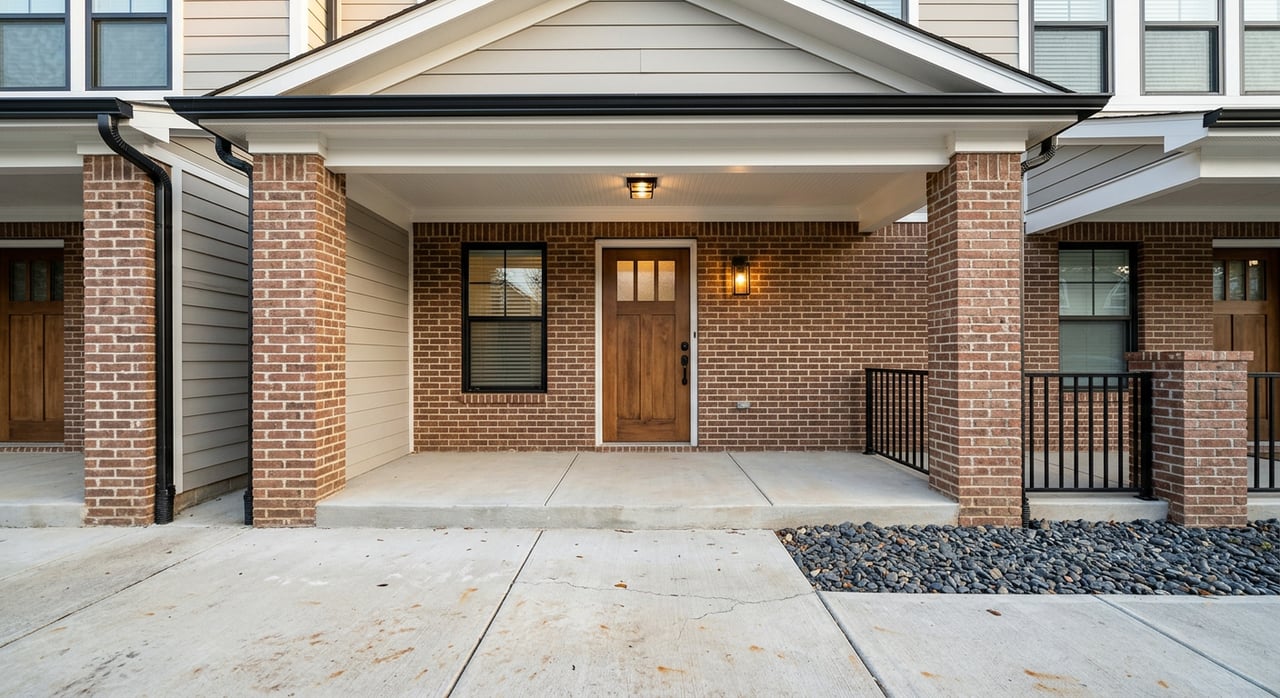
Townhomes in Sandy Springs often sit between Perimeter and the North Springs/Highpoint/Glenridge areas. They can be a great middle ground if you want more square footage than a condo and less maintenance than a detached home.
- Price range: Many newer townhome communities near I‑285 and GA‑400 start in the mid $400Ks to $600Ks, depending on finishes and location.
- Maintenance: It depends on how the community is titled. Some townhomes are condo‑style, where the association covers exteriors and common grounds. Others are fee‑simple, which means you handle your roof, exterior, and yard while the HOA maintains shared amenities. Ask for the community’s maintenance matrix before you offer.
- HOA dues: You will often see $150 to $600 per month for many townhomes and $75 to $300 per month in smaller suburban associations with lighter amenities. Always review the budget, reserves, and special assessment history to understand true cost.
- Insurance: Condo‑titled townhomes typically use HO‑6. Fee‑simple townhomes usually use HO‑3 homeowner policies. Confirm with the association documents and your insurer.
Single‑family homes: space and privacy
Detached homes are spread across Sandy Springs, with many higher‑priced properties in the western river corridor and established neighborhoods.
- Price range: The city’s 2024 report showed an average single‑family sale of $1,279,181, which reflects significant luxury sales. The spread is wide, from more modest pockets to multi‑million‑dollar riverfront estates. See examples on the city’s Top 10 Sales page.
- Maintenance: You handle both interior and exterior upkeep, yard, and private driveway. This is the largest ongoing cost difference versus condos and many townhomes. A simple planning rule of thumb is to budget 1% to 4% of the home’s value per year for maintenance and repairs, as explained in this maintenance cost guide.
- HOA dues and insurance: Many single‑family homes have no HOA, or a lighter HOA that covers only shared amenities. Dues, when present, are often $20 to $250 per month. You will typically carry an HO‑3 or HO‑5 homeowners policy that covers the dwelling itself, which can be higher than an HO‑6.
Cost comparison you can run today
To compare a condo, townhome, and single‑family home fairly, add up the full monthly and annual cost. Here is a simple way to do it.
- Purchase price and mortgage
- Keep the mortgage constant for your comparison if you can. The property type does not change your rate much except for condo project eligibility in some cases. The big differences will come from dues, insurance, taxes, and maintenance.
- HOA dues
- Use real numbers from the listing and the HOA budget. As a reference, Atlanta‑area ranges often look like: condos $150 to $1,500+, townhomes $75 to $600, and single‑family HOAs $20 to $250. See this overview of HOA fees and what they cover.
- Insurance
- Condos: HO‑6 policy plus an understanding of the building’s master policy and deductibles. Review for loss‑assessment coverage. See the Insurance Information Institute’s policy basics.
- Townhomes: The form depends on title. Condo‑titled usually uses HO‑6. Fee‑simple typically uses HO‑3.
- Single‑family: HO‑3 or HO‑5 that insures the structure and personal property.
- Maintenance budget
- Use the 1% to 4% of home value per year rule of thumb to compare apples to apples. For example, on a $500,000 home, that is $5,000 to $20,000 per year. Condos may sit toward the lower end if the association maintains exteriors, but unit‑level systems and interiors still need care. See the annual maintenance rule for context.
- Property taxes
- Georgia calculates tax on assessed value, which is generally 40% of fair market value, multiplied by the combined millage rate for your district. The basic formula is: Assessed value = 40% of purchase price. Annual tax = Assessed value × total mills ÷ 1,000. Since millage changes by year and taxing district, use the county’s tool to estimate your bill. Try the Fulton County tax estimator.
- Example only: If you buy at $600,000 and your combined millage were 30 mills, your assessed value would be $240,000 and your estimated tax would be $7,200 per year. Actual millage varies, so run your property address through the estimator.
Neighborhood fit at a glance
- Perimeter Center and GA‑400 corridor: Best for buyers who want transit access, walkable mixed‑use, and short commutes to major employers. You will find many condos and townhomes here, from mid‑rise buildings to newer townhome clusters. Proximity to the Sandy Springs, Medical Center, and North Springs MARTA stations can reshape your daily routine.
- Riverside and the Chattahoochee corridor: Larger lots, established neighborhoods, and a higher share of luxury single‑family homes. If you want more indoor and outdoor space and lighter HOA presence, this area is worth a close look.
- North Springs, Highpoint, and Glenridge: A blend of townhomes and single‑family homes with quick access to GA‑400 and Buckhead. Good for buyers who want more space but still value commute flexibility.
What to verify before you offer
Buying any property involves tradeoffs, so get the facts early. Use this checklist to avoid surprises.
Personal filters
- How much yard or private outdoor space do you need versus how much time you want to spend maintaining it?
- How comfortable are you with shared walls and vertical living?
- What matters more for your week: walkability and transit or a private lot and garage?
Financial checks
- HOA dues today, the last 3 years of increases, and any recent or pending special assessments. Ask for the HOA budget, reserve study, and minutes. See what dues usually cover in this HOA overview.
- Condo financing status. Ask your lender to review the building’s eligibility against Fannie Mae’s project rules and discuss FHA or VA options if needed.
- Insurance. Get the master policy summary for condos, confirm deductibles, and price the correct HO‑6 or HO‑3 coverage. The Insurance Information Institute’s policy guide is a good primer.
- Maintenance. Budget 1% to 4% of price per year to cover routine items and systems. Use this as a starting point and adjust based on age and size of the property.
- Taxes. Use the assessed value formula and the Fulton County estimator for a current number.
HOA documents to request
- Current budget and reserve study
- Master insurance policy summary and current deductibles
- Meeting minutes for the last 6 to 12 months
- Estoppel certificate and delinquency report
- Litigation disclosures and special assessment history
These items matter for both condos and townhomes, and they can affect loan approval for condo‑titled properties.
Which one is right for you?
- Choose a condo if you want low upkeep, elevator convenience, and walkability near Perimeter and MARTA. Weigh dues against reduced exterior maintenance.
- Choose a townhome if you want more space and a garage with less yard work than a house. Confirm whether the association or you handle exterior maintenance.
- Choose a single‑family home if you want maximum privacy, a yard, and room to grow. Plan for higher maintenance and potentially higher insurance.
If you want help pressure‑testing the numbers for a few listings, I can pull HOA docs, coordinate a condo project review with your lender, and run a tax estimate so you can compare total carrying costs side by side.
Ready to narrow your search to the best match for your budget and lifestyle? Reach out to Joshua Vigliotti to schedule a consultation and get a customized Sandy Springs plan.
FAQs
Will condo dues make my costs lower than a house in Sandy Springs?
- Not automatically. Add HOA dues, HO‑6 insurance, property taxes, and a maintenance allowance, then compare to a house with HO‑3 insurance, likely higher maintenance, and possibly higher taxes. The 1% to 4% maintenance rule helps you run the numbers.
Are condo buildings in Sandy Springs hard to finance?
- Some require project reviews for conventional loans, and FHA or VA may need single‑unit approval. The key is to involve your lender early and verify project eligibility against Fannie Mae’s standards.
Do townhomes always have lower HOA dues than condos?
- Not always. Dues vary by structure and amenities. Smaller townhome HOAs can be lower, but weak reserves or special assessments can offset that. Review the same HOA documents you would for a condo.
How do property taxes work on a Sandy Springs home?
- Georgia taxes are based on 40% of fair market value times the combined millage rate. Because millage changes by area and year, use Fulton County’s estimator for a personalized number.
What HOA documents should I see before I make an offer?
- Ask for the current budget, reserve study, master insurance summary, minutes for 6 to 12 months, delinquency report, litigation disclosures, and any special assessment history so you can gauge risk and future fees.